
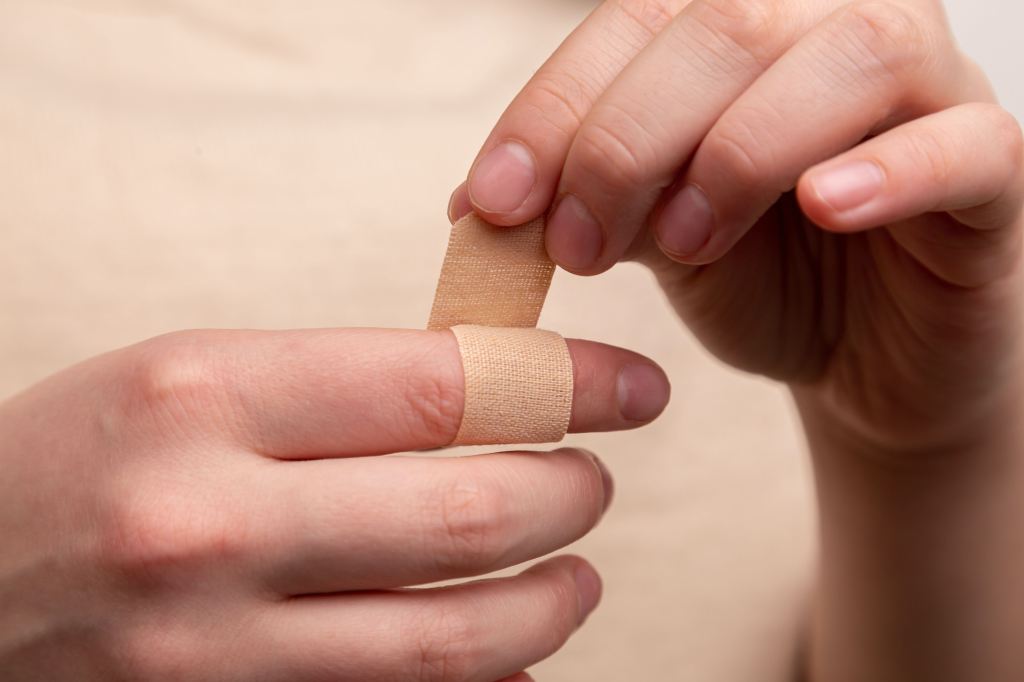
There I am bleeding to death – well not exactly – while fumbling with the stupid little tab at the top of the wrapper. It seems simple enough; all you have to do is separate it and peel the package neatly open. In reality, I invariably paw away at the thing, which seems intent on sticking to itself, get frustrated, and tear the wrapper open, ripping the flimsy bandage inside.
And if I do manage, by holding my mouth in exactly the right contortion, to peel the white tabs off the sticky part, when I try to precisely place it over the wound, the darn thing becomes self-aware and adheres to anything but the place I want it to stick.
I have a further issue with ‘waterproof’ bandages. How can they be waterproof with all those little holes in them? Answer; they’re not. There are some brands that claim their bandages are impermeable. They’ve obviously never washed dishes using a sink (not a dishwasher) and probably aren’t the kind of people you want to shake hands with because they don’t use the soap dispenser after they poo.
Now of course, all this fussing with bandage wrappers led me to hit the internet to research bandage technology. Lo and behold, I find the actual Band-Aid people have ‘healing bandages [which] comfortably mold to your skin, forming a 100% waterproof, germproof, dirt-proof seal—that moves with you so you can move on with your day.’ Sounds like a perfect solution, but they probably still come in an impossible-to-open package. I wasn’t able to confirm or deny this fact because my local drugstore doesn’t carry the latest technology in bandages – just the prehistoric kind.
The Band-Aid website does have a lot of useful information about wound care though, and tells the story of how a Johnson and Johnson employee, Earle Dickson invented Band-Aids in the 1920’s. Apparently, he invented a homemade version for his ‘loving’ wife, Josephine who dutifully had dinner waiting on the table when he came home every night, and as she ‘worked hard to keep their home beautiful’ sometimes ‘suffered for her work by getting cuts or minor burns on her fingers.’
The resourceful Josephine would cut a strip of cotton gauze and use adhesive tape over it to dress her wounds. So, technically it was Josephine who came up with the idea for Band-Aids, but of course, clever Earle had a brainwave. ‘He sat down and prepared some ready-made bandages by placing squares of cotton gauze at intervals along an adhesive strip and covering them with crinoline. Now all Josephine had to do was cut off a length of the strip and wrap it over her cut.’
Crinoline sounds a lot easier to deal with than the bandage wrappers of today, they should probably have stuck with the original design.
Image: Photo by Diana Polekhina on Unsplash


 by angela lovell